Inside McDonald's Kitchen: How Its Food Is Actually Cooked
Clamshell grills, seven-minute fries and a batter built to survive delivery. A look at the cooking system behind the world's biggest restaurant chain.
McDonald's has never claimed to sell the best burger in the world. What it promises is the same burger, everywhere, every time. The whole kitchen is built around that promise: every item has a specification for weight, temperature, cooking time and holding time, so nothing depends on the mood of the cook.
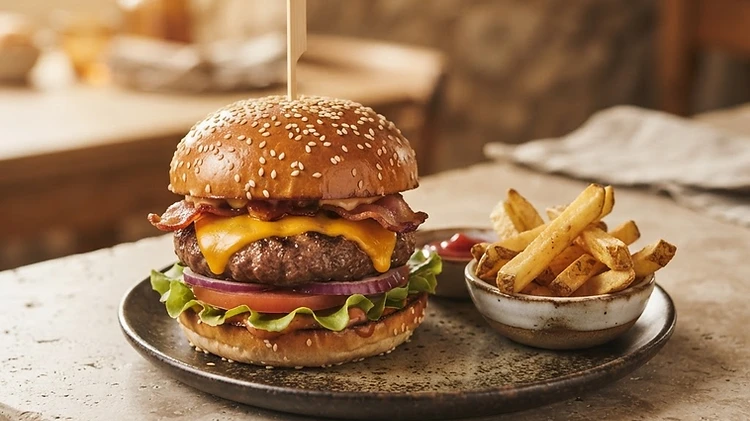
Beef patties. The standard hamburger patty is cooked from frozen on a two-sided clamshell grill. Both plates close on the meat at once, so the patty is seared top and bottom and is ready in well under a minute, seasoned with nothing more than salt and pepper during cooking. In the United States the Quarter Pounder is the exception: those patties arrive fresh, never frozen, and are cooked to order on a separate grill, which is why it takes a little longer.
Fries. McDonald's fries are cut and partly cooked at the supplier. They are blanched and par-fried so the inside is cooked while the outside stays pale and soft. In the restaurant they get a second fry in a blend of vegetable oils, then salt. The holding time is short, about seven minutes under the heat lamp, and fries past that are discarded. That single rule explains why the fries at a busy branch taste so much better than at a quiet one.
Chicken McNuggets. White meat chicken is ground and formed into the four shapes, lightly battered in a tempura-style coating, breaded, par-fried at the factory and finished in the fryer in store. The coating is designed to stay crunchy through a delivery trip, which is why nuggets survive a box better than most fried food.
Breakfast. The Egg McMuffin shows how the system works. A fresh egg is cracked into a metal ring on the griddle, the yolk is broken, and the egg is steamed and turned, so every sandwich gets a round egg of the same thickness. Nothing about it is difficult, it simply has to happen the same way a million times.
Grills are cleaned on a fixed schedule, frying oil is filtered on a fixed schedule, and every timed product carries a holding time on its packaging. Staff are measured against QSC and V, the standard Ray Kroc set out in the 1950s: quality, service, cleanliness and value. That is why McDonald's food is safe and predictable rather than adventurous.
Halal. McDonald's United Kingdom states that the chicken it serves is halal certified, while items such as bacon and some beef products are not, and a small number of restaurants are excluded, so it is worth checking your local branch. In Pakistan, Malaysia, Indonesia, the UAE and Saudi Arabia, McDonald's menus are halal. In the United States the menu is not halal certified.
So why is it better than many other chains and takeaways? Consistency first: the same order tastes the same in Lahore, London and Los Angeles. Then speed, price and food safety. Value menus and app offers bring a full meal down to a few dollars or a few pounds, and the chain's standards mean a bad experience is unlikely even in a city you have never visited before.
Two offers are worth knowing right now. In the United States, the $5 Meal Deal gives you a McDouble or a McChicken with four Chicken McNuggets, small fries and a small drink. In the UK, the Meal Deal Plus adds a bonus side to a cheeseburger, medium fries and a cold drink. Both are listed in our Food Deals section, and both vary by restaurant, so check the McDonald's app for your local price.
One honest note: this explainer is written from McDonald's own published material, its UK halal statement and public reporting on its kitchen standards. Menus and processes change, and halal certification is market by market, so always confirm with the restaurant you actually eat at.
Sources
McDonald's official US and UK websites; McDonald's corporate newsroom on the $5 Meal Deal and fresh beef Quarter Pounder; McDonald's UK halal statement.
Explore by hashtag