KFC vs McDonald's Preparation Methods: How Two Fast-Food Giants Actually Cook
One chain breads chicken by hand and pressure-fries it under steam; the other grills frozen patties flat in under two minutes. The two kitchens behind KFC and McDonald's explain why their food tastes the way it does.
Two of the most recognisable kitchens on earth cook in almost opposite directions. Step behind the counter at KFC and you will find flour bins, pressure fryers and a person breading chicken by hand. Step into a McDonald's kitchen and you will find a clamshell grill, a sauce gun and a tray system built around seconds rather than minutes. Understanding those two methods explains a great deal about the food that comes out of them: why KFC's crust shatters, why a Big Mac tastes the same in Seoul, Karachi and Sao Paulo, and why the two chains almost never copy each other's approach.
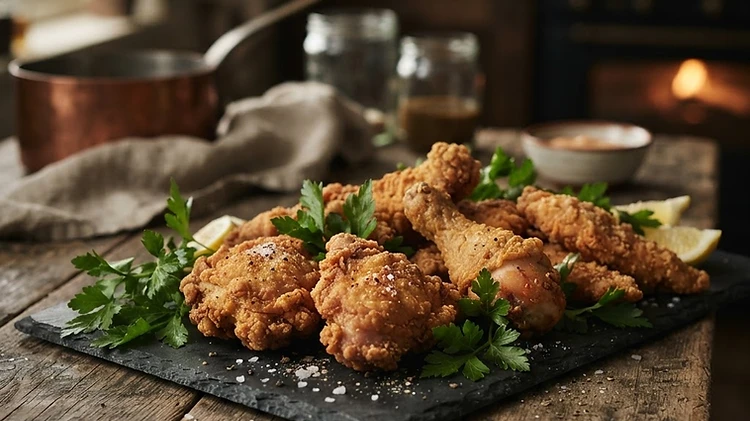
KFC's process begins before any heat is applied. Chicken is cut into pieces and marinated, usually in a seasoned brine containing salt, monosodium glutamate and, in many markets, milk or egg powders that help the coating grip the meat. The breading itself is a flour blend with eleven herbs and spices, and it is applied by hand: pieces are pressed into the flour, turned, and pressed again. That repeated handling builds the uneven, craggy surface that gives finished KFC chicken its texture. The blend is not identical everywhere. Sugar, chilli and spice levels are adjusted for local palates, which is why fried chicken sold under the same logo can taste noticeably different in Lagos, Kuala Lumpur and Louisville.
Frying is where KFC truly separates itself. Most fried chicken in the world is cooked in open oil. KFC uses a pressure fryer, a sealed vessel that cooks the chicken under pressure at roughly 175 degrees Celsius for around twelve to fifteen minutes. Pressure raises the boiling point of the moisture inside the meat, so the chicken cooks faster while losing less water; because steam cannot escape freely, the interior stays juicy while the coating sets into a hard, dry crust. The double-breaded crispy range is coated twice and finished in an open fryer for a heavier, crunchier shell. Cooked pieces are then held under heat lamps with strict holding times, and anything unsold beyond that window is discarded.
McDonald's built its reputation on the opposite principle: standardisation. Beef arrives as pre-portioned discs of ground beef, frozen or chilled, and the classic ten-to-one patty used in a Big Mac is cooked on a clamshell grill that presses a heated upper plate onto the meat. A quarter-pound patty is typically done in under two minutes, with the two hot surfaces browning both sides at once while the pressure keeps the patty flat. Only salt and pepper go on at the grill. Buns are toasted on a separate griddle, sauces are dispensed from portioning guns, and the burger is assembled in a fixed order of layers: the fast-food equivalent of a manufacturing line.
The fries take a more interesting route. Potatoes are cut, blanched and partly fried in the factory, then dipped briefly in a dextrose solution that keeps them pale and helps them colour evenly. In the restaurant they get a second fry in a blend of vegetable oils, are salted immediately, and are held under lamps for a short window before being thrown away. In the United States the frying oil blend still carries a beef-derived flavouring, a detail that matters to vegetarian customers and to anyone reading ingredient lists carefully.
Chicken nuggets follow a similar logic. They are formed from finely ground chicken breast meat, shaped, coated in a light batter and breading, flash-fried in the factory to set the coating, then frozen and fried again to order in the restaurant. That two-stage frying is the same trick used in frozen supermarket products: it locks in moisture and gives the coating its shell.
The two chains also differ in how much of the work happens before the restaurant. KFC's flavour is built in the kitchen, by hand, at a breading station. McDonald's flavour is built in the factory, in the patty specification, the bun recipe and the sauce formula. One system depends on trained hands and tolerates small variation. The other depends on tight specifications and tolerates almost none. Both are engineering answers to the same question: how do you serve identical food to millions of people every day?
For Muslim diners, neither method is inherently halal or haram. What matters is the source and slaughter of the meat, the absence of pork-derived ingredients such as gelatine, lard or certain flavourings, and whether the restaurant itself is certified and free of cross-contact with non-halal items. Both brands run certified halal restaurants in many markets and non-certified ones in others, including most of the United States. Certification is granted per country and often per branch, so the sign on the door matters more than the logo above it.
Home cooks can borrow from both kitchens. A buttermilk or yoghurt brine with plenty of salt is the single biggest improvement you can make to homemade fried chicken, and a second fry at a higher temperature after a short rest will push the crust closer to what a commercial pressure fryer produces. For burgers, chilling the patties, salting only at the moment they meet the pan, and toasting the buns in the same fat will get you closer to a drive-through burger than any secret sauce recipe will.
Fast-food recipes are closely guarded and change over time and between countries. This article is based on the companies' own published ingredient and cooking information and on widely reported descriptions of their kitchen processes, so treat exact timings as typical rather than guaranteed. Check locally for the current menu and halal certification.
Explore by hashtag