Indian in USA: What an Unlimited Indian Buffet Actually Gets You
The unlimited Indian buffet is an American institution. What is on it, how to judge one, and the halal question you must ask.
The unlimited Indian buffet is an American institution. It is in the strip malls of New Jersey, the lunchtime offices of Manhattan, the suburbs of Chicago, Houston and Dallas, and it is usually the cheapest full Indian meal in the country.
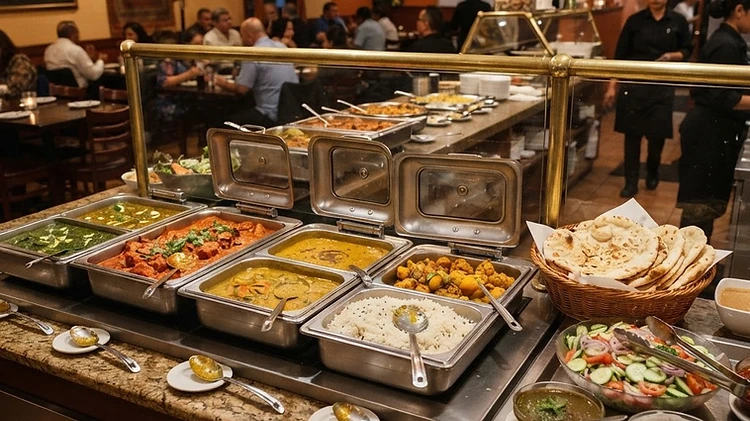
What is actually on it. Salad and chutneys first, then tandoori chicken, chicken tikka masala, a lamb or goat curry, dal makhani or dal tadka, palak paneer, aloo gobi or a seasonal vegetable, biryani or plain rice, naan and papad, and something sweet — gulab jamun or kheer. Ten to twenty dishes for one price, and you go back as often as you like.
Why it is cheap. A fixed menu cooked in large batches, high turnover at lunch, and fewer staff on the floor. It is the most efficient way an Indian restaurant can feed a lot of people, and the saving is passed to the customer at lunchtime, when the trays are guaranteed to be emptied and refilled.
How to judge one in five minutes. Look at the turnover: trays that are nearly empty at the bottom mean the food is moving, and food that moves is fresh. Look for a tandoor or a visible kitchen. Check that the naan arrives hot rather than from a stack. Taste the vegetarian dishes — palak paneer and dal tell you everything about a kitchen, because they cannot hide behind spice. And check the salad and chutneys: a buffet with tired chutney is a buffet that does not care.
The halal question. Many Indian and Pakistani buffets in the United States are halal, and plenty are not, and ownership can change. Ask before you eat, and ask specifically: is the meat halal? Is it certified? Are the vegetarian dishes cooked in separate pans from the meat? A buffet that serves both will often tell you honestly, and the answer decides whether you eat the curries or stick to the vegetarian half of the table.
The entirely vegetarian buffet. Some South Indian buffets are fully vegetarian, which removes the question completely and usually improves the value: unlimited dosa, idli, vada, sambar, three or four curries, rice, bread and a sweet. If you are unsure about a mixed buffet, look for one of these.
How to eat it well. Go at the start of service. Take the tandoor items and the curries first, treat rice and bread as support rather than filler, and leave the fried starters for one plate only. Drink water or lassi rather than filling up on soda, and finish with one sweet rather than three.
What it is not. A buffet is not a restaurant menu. It is the greatest hits cooked for volume, and the things that suffer are the delicate dishes — fish, biryani layers, anything that needs to be made to order. Order off the menu when you want the kitchen's real cooking.
Where they are dense. Queens and Long Island in New York, Edison and Jersey City in New Jersey, Devon Avenue in Chicago, Hillcroft in Houston, the northern suburbs of Dallas, Atlanta, and the Bay Area. Almost every Indian population centre in America has at least one.
If you are new to Indian food, a buffet is the cheapest education available: one plate of ten dishes tells you what you like, and then you can order it properly for the rest of your life.
Sources
Guide to Indian buffets in the United States. Prices and menus vary by city, so check with the restaurant.
Explore by hashtag

